|
Trimlines
of the orthosis
The way to cut or trim an orthosis is the same for a mixed orthosis,
and can be done according to the technician's normal procedures.
In the Rehabilitation Centre for Disabled Children, the orthoses
have no ankle joints, because they tend to wear away too quickly.
This is compensated for by a more posterior cut of the forefoot,
which makes walking easier.
Joint
assembly
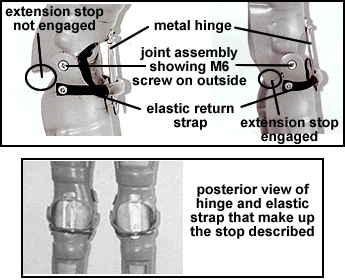
The axis of the orthosis is made of two M6 nuts, with an external
diameter of 8 mm, placed on the inside of the joints and two
countersunk M6 screws placed on the outside (Figure 3).
Lock
fitting
The lock (posterior) is made of a hinge (e.g. the metal hinge
of a cupboard) and of an elastic return strap (inner tube). The
ends of the elastic return strap are fixed on each side of the
leg segment and go back and round the leg to control the lock
(See Figure 3).
In
Vietnam, a special mold has been set-up and built for this use,
recycled polypropylene is used to make this lock component.
Straps
assembly, fitting and delivery
This phase is the same for any kind of orthosis. In Vietnam,
the location for the straps are directly cut in polypropylene,
which makes buckles unnecssary. The nylon, velcro and moss straps
are removable and can easily be washed or replaced.
|
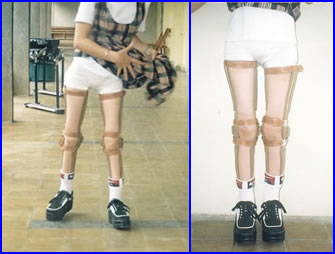
The completed
orthosis
Follow-up
at home
The systematic
at home follow-up of the devices is also an important part of
the process. It is the only way to be sure that the technology
used meets the demands of the living conditions and the environment
of the user. In Vietnam, this follow-up was implemented when
it was noticed that a major proportion of devices were not being
used. The most important reasons are:
· The stay in the rehabilitation centre was too short
to try the device and to practice walking again.
· Delivery of devices through mobile teams was performed
without trying it on.
· Impossibility for the user to transport themselves to
the rehabilitation centre to adapt the device or simply to replace
the damaged straps.
· Devices that have become too small due to the growth
of the user.
Now,
this at home follow-up guarantees that more than 90% of the devices
(prostheses and orthoses) are actually being used. It also accounts
for an important part of the training of new users.
1
The joint screw mechanism is now being made out of polypropylene
since this article was written.
HANDICAP
INTERNATIONAL
Jean Claude Vesan
Orthotist-Prosthetist / Technical Coordinator
Tel/Fax : (84-8) 864 39 31
E-mail : handicap@hcm.vnn.vn
|
