|
Handicap International, like
many non-governmental organizations involved in orthopaedic devices,
used to focus on prostheses supply, the first priority in post-conflict
times. Our actions in low-income countries (often in the framework
of community-based programs), where poliomyelitis or cerebral
palsy are the major causes of disabilities, has now led us to
develop our expertise in the field of orthotics, destined for
a more varied and numerous target population.
Traditionally, the most commonly
used technology in developing countries has been the metal orthosis
(aluminium, steel, etc.), which simply requires basic equipment.
On the other hand, this kind of device is heavy and unaesthetic
and also obliges one to wear a closed or half-closed shoe, which
is hardly supported by children in tropical climates. In addition,
the identification and purchasing of good quality sidebars and
joints is often a problem.
Thanks to socio-economical progress
in some of these countries, a new type of orthosis could be fabricated
by different agencies: the "mixed" orthosis. This orthosis
uses thermoplastics, which are more comfortable and more precise,
and which do not require any special footwear. The purchasing
of sidebars and joints for this orthosis, however, is still a
problem. This "transitory" technology was already an
important step for our beneficiaries. However, in Vietnam, the
motivation and the technical level reached by Handicap International's
partners allowed us to progress further. In the Hô Chi
Minh Ville Rehabilitation Centre for Disabled Children, the polypropylene
knee joint for lower-limb orthoses was created, showing new properties:
· Fabricated solely of
polypropylene, with the exception of the articulating screws,
the straps, and the locks1
· Weight: For a 50 kg user, for example, the knee-ankle-foot
orthosis is only 550 g. This is an improvement of approximately
30% in comparison to a mixed orthosis, and a 40% improvement
compared to an aluminium orthosis
· Independence from steel joint and sidebar supply
· Improved function of the device, due to the improved
stiffness of the knee, maintaining both joints in the proper
alignment
· Easy repairs of the lock and the joints
· Wider distribution of the posterior knee pressures,
allowing more comfort, particularly in case of genu (knee) recurvatum
· Cost of the device, decrease for the joints and sidebars
· No particular knowledge or material needed
Fabrication
This technical description will only be related to the specific
process, not the general principles of any orthotic device. In
addition to the basic material used for mixed orthoses, a polypropylene
joint requires:
· One alignment guide, composed of a threaded rod with
an 8 mm diameter, and two aluminium cylindrical pieces of 35
mm diameter
|
· One 6 mm drill, to be
used for rounding off the joints' heads
· One hinge, used for the making extension stop
· One circular saw with a 100 mm blade, to be adapted
on a drill for the manufacturing of the extension block stops
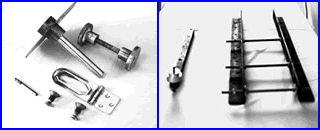 Required
Materials Required
Materials
Casting & measurements
The patient is standing in a corrected position, the hip joint
in 6o of external rotation, knee straight, and ankle at 90o.
Particular attention must be paid to the following measurements:
· Diameter above the condyles
· Knee joint axis diameter
· Ankle malleolus diameter
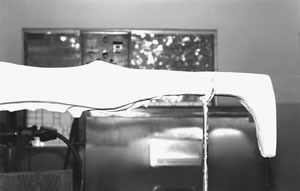 Positive Mold Positive Mold
Positive mold plaster correction
Taking these measurements into account, rectifications are performed
on the anterior of the leg cast in order to make the donning
of the orthosis easier.
Joints guide positioning
Thanks to a round "surform" file, the positive mould
is carved to make room for the alignment guide. To increase the
security of the lock, the alignment guide should be placed in
a more posterior position than normally placed. A minimum distance
of 1cm behind the joint's physiological axis is appropriate.
The alignment guide protrudes on each side (medially and laterally)
of the positive mold, by 3 mm.
|


