| Introduction | Geopolitics | Population | Development | Environment | Home |

| Glossary | Atlas | Search | Discussion | News |
| Introduction | Geopolitics | Population | Development | Environment | Home |
| Glossary | Atlas | Search | Discussion | News |
 Food
Food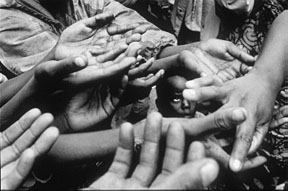
Who is hungry? What is hunger? Why are people hungry? Some important questions to ask. Everyone has experienced hunger at one point in their life but the hunger we need to examine is felt by those people who lack enough food on a daily basis.
Hunger can be thought of as the craving of food or the pain associated with the lack of food. It should not be confused with malnutrition which is the lack of proper nutrients for the human body to function. The distinction can be summed up as hunger refers to the lack of quantity of food and malnutrition refers to the lack of quality of food.
Why are people hungry? This is often a complicated question to answer since many factors impact on the issue. Most factors relate to the political and economic struggles within countries which affect the distribution of food. More discussion will follow.
Actually there is plenty of food in the World.
Production of cereals (wheat, rice, millet etc.
last year reached 1 799.2 million tons, enough
to offer everyone in the world well over the
recommended minimum of 2,500 calories
per adult per day. And that is before you've
even begun to count the calories in
vegetables. nuts. pulses. root crops and
grass-fed (as opposed to grain-fed) meat.
So what's the problem?
The problem is the distribution of that food, both within countries and between rich and poor worlds. People like us in the developed nations eat much more than we need. Americans represent only six per cent of the World's population, yet they consume 35 per cent of the world's resources - the same as the entire developing world. So is the real world population problem that there are too many Americans? Or Canadians or people in developed nations who consume at such high rates?
But Western countries have enough land to support their populations - Third World countries don't.
Western countries have enough money to support their populations. There is little relationship between hunger and the availability of land. Holland has 1,117 people per square mile and Bolivia just 12, yet the Dutch are one of the best-fed people in the world and the Bolivian poor among the world's most undernourished. We think of India as overpopulated yet it has 568 people per square mile, less than Britain's 583. And Africa may have the world's greatest food problem - but it isn't for the lack of land. At the moment only a quarter of Africa's potential arable land is being cultivated.
But doesn't Africa have the world's fastest population growth?
Yes and no one is saying they shouldn't be concerned about that. Contraception should be freely available to everyone who wants it. But people are only likely to use it when their poverty is relieved. When one in four children dies and more hands are needed to help in the fields, children become an economic necessity. The rich world's population growth slowad when standards of living improved - before the advent of reliable contraception.
The weather does not cause famines - people do. Earthquakes and floods. droughts and cyclones may be natural disasters but humans decide who will suffer from them. When the recent cyclone hit Bangladesh, for instance, it was only the poor that died. Only the poor were desperate enough for land to make the dangerous move onto the new islands that appear every year in the Bay of Bengal. Red Cross statistics show that, in high-income countries, the number of people killed per disaster is under ten per cent of that killed in low-income countries.
That's all very well, but people are dying in Africa now because it hasn't rained.
No. they're dying because they're poor. Farmers starved in US droughts in the 1890s and 1910 but they don't starve when drought hits now. Saudi Arabia has greened part of its desert to make itself self-sufficient in wheat. So it is clearly money that counts.
The climate in Africa may be changing - we don't know yet. But what we do know is that more people are dying in droughts than before - an average of 23,110 people per year died in droughts in the 197Os compared with only 1,010 per year in the 1960s.
This is partly explained by the increased frequency of droughts - the number grew from 5.2 droughts per year in the World in the 1960s to 9.7 per year in the 197Os. But the reason so many more die in each drought,is that people are being pushed into poverty - the weather simply tips them over the brink.
We would all like to think that scientific progress could cure our ills. And solving the World's food problem might seem easy compared with sending rockets to Venus. But science's solution to global hunger- the Green Revolution - has been no solution at all. In fact in some places it has made the gulf between rich and poor wider.
How can that be? The Green Revolutlon introduced seeds that yielded bigger crops.
Yes. but high-yielding seeds only work if they're in laboratory like conditions. They need artificial fertiliser and an irrigation system that is beyond the means of the small farmer.
Even so. more food is grown and that must be good for everyone.
Not necessarily. Take two farmers, one with
barely enough land to eke out a living, while the
other is rich in land and capital. Both are
persuaded of the value of high-yield seeds. But
the first has no money for the fertiliser the new
seeds need, and is too poor for the bank to offer
a loan. So while the large farmer has a bumper
harvest, the small one grows the same or less
than usual - and has to sell at a lower price due
to the market glut. Eventually the poor farmer
will have to sell out to the rich to make ends meet.