|
|
|
|
|
|
|
|
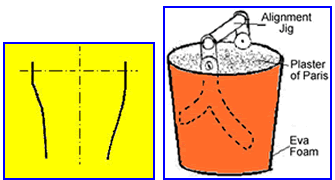 A ten centimetre wide strip of EVA (foam) is rolled into a circle shape, to a diameter almost equal to that measured on the patient's contralateral side (I found two sizes generally fit most patients). The distal uprights are placed inside the roll of EVA, still attached to the caliper jig to maintain alignment as well as the medial-lateral measurement, (Figure 2). Plaster of Paris (POP) is then
poured inside the roll of EVA. Once the plaster has set, the
EVA roll and joints are removed from the plaster mould. 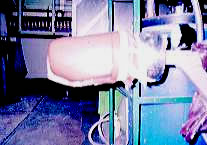 Fig.3: first vacuum molding without the joints Before molding the second layer, the joint stirrup is affixed on top of first layer (this does not require any space between the stirrup and the first layer). The uprights should be fixed, so as not to be displaced during molding, (Figure 4). Once molding is complete, the joints will be sandwiched between two layers of polypropylene. The proximal uprights of the metal joints are then bent to meet the socket. Assembly of
the knee disarticluation component |
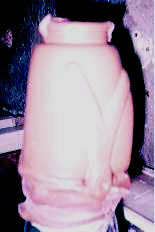 Conclusion It is easy to adjust a prosthesis made with these components in both static and dynamic alignment. The possible adjustments include anterior and posterior displacements, medial and lateral displacements, extension, and flexion, which can be done in the cup of the component. The knee disarticulation component
like other polypropylene components from the ICRC, can be ready
made in different sizes, which hastens the assembly process.
Fabrication of the joint as described here consumes only 20 hours
of labour. It should be a great help to many workshops in low-income countries if the ICRC would integrate this prosthetic knee component into component production. This could assure high quality of the material, design and function of the component. Thanh.vietcot@netnam.vn Address: Vietnamese Training Centre for Orthopaedics Technologists (VIETCOT)50 Giai Phong Road. Hanoi-Vietnam Tel: 00-84-4-5740914 |
|
|
|
