|
It is well known by prosthetic
professionals in developing countries that adequate components
for knee disarticulation prostheses, priced affordably and adaptable
to the environment, are not currently available.
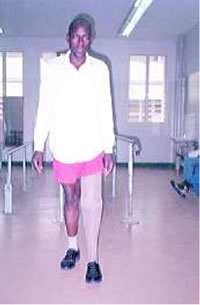
Patient
walking with a knee disarticulation prosthesis
When the P&O practitioner
is confronted with the design and production of a knee-disarticulation
prosthesis, he or she has to select either a component for trans-femoral
prostheses (such as conventional uprights for leather thigh corset,
where the knee joint is integrated into the laminated shank),
or high price modular components (available in industrialized
countries).
The polypropylene prosthetic
component system developed by the ICRC (International Committee
of the Red Cross) takes into account the environment, price,
and adaptability necessary for use in developing countries. This
is a modular component system, with components available for
trans-tibial and trans-femoral amputees. Until now, no components
had been developed for knee-disarticulation prostheses. Therefore
it became essential to develop a prosthetic component suitable
to fit to a knee disarticulation prosthetic system widely used
in the environment described above.
|
The objectives were:
- To design a new knee disarticulation component using polypropylene
and metal uprights (both of which are readily available).
- To assemble knee disarticulation components that can be incorporated
with the polypropylene trans-tibial componentry developed by
the ICRC.

ICRC components
on the left and then incorporated with the
knee disarticulation component on the right
Six patients were identified
and selected at random for this project. After measurements were
taken, it was decided to develop two different sizes of knee
components.
Fabrication of the component
As Figure 1 illustrates (next page), the distal or lower upright
of the metal joint is bent according to the shape and contour
desired. This should been done with the joints attached to an
alignment (caliper) jig (Figure 2) to maintain proper alignment
of the joints. One must also remember which side is being fabricated
(left or right).
|


