|
In 1993, the
ICRC decided to offer the possibility of more advanced training
in certain programs, leading to a Certificate of Professional
Competence (CPC), issued jointly by the ICRC and the local authorities.
Requirements are at least 3 years apprenticeship under supervision
of a qualified prosthetist/orthotist and the successful completion
of an examination in the presence of external examiners. This
certificate meets the need for recognition of acquired competencies
in countries where the normal education system is interrupted.
So far, 59 technicians in 6 countries (Chad, Lebanon, Syria,
Sudan, Georgia, and Azerbaijan) have successfully passed the
exam. Forty technicians passed similar exams before 1993 in Nicaragua
(12) and Ethiopia (28).
In some countries
training is conducted up to the ISPO Category II standard, in
close consultation with the International Society for Prosthetics
and Orthotics (ISPO). This is organized in unique, modular, one-off
work-study courses. Thirty-five students passed this exam in
Mozambique (23), Georgia (5) and Azerbaijan (7). During the year
2002, 32 national orthopaedic technologists were employed in
49 assisted projects.
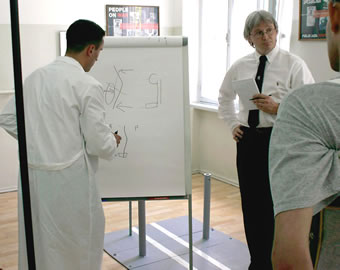 ISPO Category II final examination in the Caucasus
In addition to
these three training programs, the ICRC's Special Fund for the
Disabled in Addis Ababa, Ethiopia, offers month long refreshment
courses in the manufacture of prostheses using polypropylene
technology. This course, free of charge, is aimed at national
staff of assisted projects and first mission ICRC prosthetists/orthotists,
but is also open to non-ICRC candidates.
Since 1995, this course was attended
by 203 national staff and some 35 ICRC first mission prosthetists.
|
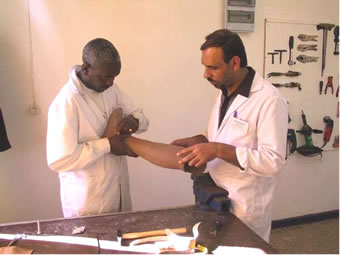
Refresher
course in the ICRC polypropylene technology
Parallel to the in-house training
courses, the ICRC sponsors national staff to attend nationally
or regionally established prosthetic/orthotic schools for training
or upgrading. More than 20 students from assisted programs have
been or are presently under training in four schools (Cambodia,
Vietnam, Tanzania, El Salvador).
Training has contributed to improving
the quantity and quality of fittings and increased the prospects
of creating self-sustainable projects.
Since 1979, patients in 73 assisted
projects were fitted with 194,772 prostheses and 87,458 orthoses
during the period of assistance. The real number of beneficiaries
is higher however, when one takes into account the patients who
were fitted in the projects from which the ICRC has since withdrawn
(full-time) assistance, for example Chad, Colombia, Lebanon,
Mozambique, Rwanda, Syria, Uganda and Zimbabwe.
On the other hand, the combination
of unsatisfactory economic circumstances with a higher degree
of training, risks migration of qualified staff to better paid
employment opportunities elsewhere. In Sudan and Nicaragua, more
than half of the trainees left the assisted centres within 3
years after completion of the course. The level of training is
directly related to the quality of prosthetic/orthotic fit for
the patient and also to the prospects of sustainability of the
project. It is important that conditions are created to provide
adequate employment after training so that these individuals
stay in areas of need.
Training is essential in addressing
quality, quantity and sustainability, but major constraints do
exist. The training goal for the ICRC is therefore to first identify
and address the most essential needs in each project. Due to
the limited existing health infrastructure, the priorities most
easily addressed are often lower limb amputees, followed later
by patients in need of orthoses and upper limb amputees.
In consultation with the ISPO
and others, efforts are ongoing to standardize a methodology
for the implementation of a basic training course with corresponding
teaching packages. The course should offer prospects for upgrading
to an internationally recognized level, if and when conditions
allow. Part II of this series of articles will provide more information
on this topic.
|
