|
An amputee has
a permanent disability and will need access to rehabilitation
services for the rest of his or her life. Provision of these
services is particularly problematic in countries with war or
internal conflict, where large numbers of amputees and people
with disabilities live. In these regions, most service provision
systems and educational systems have collapsed. Assistance programs
for new or existing centres often need to start from very basic
levels. The International Committee for the Red Cross (ICRC)
has an assistance approach which focuses on technical assistance
for prosthetics/orthotics service delivery systems, introduction
of low cost/good quality technology and prosthetics/orthotics
teaching to national staff. This series of articles focuses on
the teaching programs for national staff.
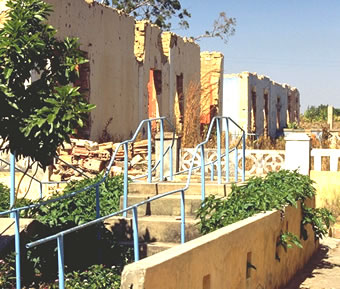
Collapse of service provision
systems
The context in
which programs are carried out is important in understanding
their main constraints. First, one must consider the poor economic
and security situations of the countries in which the ICRC usually
operates. Poverty, hunger, uncertainty, insecurity and lack of
career prospects do not offer a positive climate to motivate
national staff for training and prosthetic/orthotic service delivery.
Though prosthetic/orthotic centres are not usually located on
the front-line, the security situation may suddenly change and
affect the centre. For instance, during the year 2000, the prosthetics/orthotics
center in Jaffna, Sri Lanka was forced to change location 3 times
because of urban warfare. In 1990, two members of the ICRC were
kidnapped in Lebanon. Another important consideration is that
the prosthetics/orthotics needs of war victims must be addressed
within a reasonable lapse of time. New action is usually a result
of an influx of recently war-wounded patients. The fitting of
these patients cannot await the completion of a conventional
training course for national staff. Thus, an important part of
the resources and energy is spent on setting up and improving
the patient services accessible to patients.
|
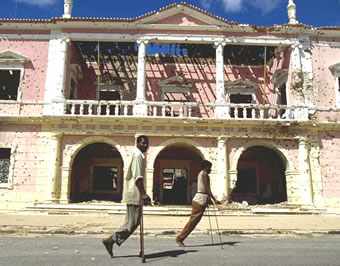
Poverty, insecurity and
lack of career prospects
A further problem
is the insufficient basic and/or mid-level education of the national
staff to be trained due to collapse of the country's educational
system and /or the emigration of educated personnel. Training
and upgrading possibilities of already employed staff can be
limited due to their insufficient basic education. Furthermore,
it can be difficult to recruit additional employees with sufficient
background.
Currently there
are several hundred national technical staff following continued
training in the assisted centres every year. According to the
circumstances, three types of in-house training can be distinguished.
On-the-job training is given
in all programs and is the backbone of each program. The maximum
number of apprentices per qualified prosthetist/orthotist is
6 students. The training is flexible, depending on the situation,
progressing from demonstrations to close supervision by the prosthetist/orthotist,
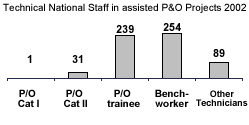
and is generally combined with limited theory. During the year
2002, 271 technicians involved in prosthetics/orthotics fitting
and 243 other technical employees including bench workers received
on-the-job training.
|



