|
|
|
|
|
|
|
|
|
Proper alignment in the frontal plane should result in a more narrow base of gait, and decreased energy spent in walking. The goal is to duplicate the normal knee position (normally varus) at mistance, and ensure appropriate loading of the medial flare of the tibia (a force tolerant area). If cosmetic finishing of the prosthesis is a problem, the foot can be out-set (lateral) minimally to improve the cosmetic shaping of the prosthesis. Imagining the "center of socket" in the frontal plane, a plumb line should fall roughly through the center of the posterior shelf of the prosthetic socket (this shelf would normally be horizontal, reflecting the frontal plane shape of the limb - not tilted one way or the other). The plumb line should then fall through the center of socket, and bisect the middle of the heel of the foot when looking from behind (Figure 3). 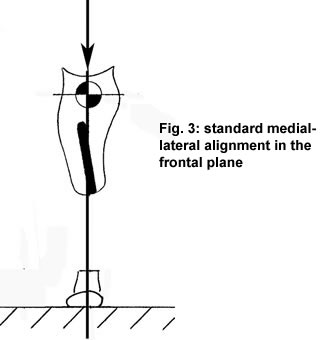 |
Looking down on the trans-tibial socket from above (transverse plane), it should be possible to draw an imaginary line that will go from the middle of the posterior shelf, through the PTB (patellar tendon bar), bisecting the second toe of the prosthetic foot. In the transverse plane the angle of toe out of the foot should be set to five to seven degrees. This angle can be determined with most prosthetic feet by placing the medial border of foot parallel to line of progression of the way the amputee walks. This may need to be altered during static and dynamic alignment to match the toe-out angle of the normal foot. The importance of proper bench alignment cannot be stressed enough. While it is of course possible to alter the alignment of a prothesis once it has already been assembled, aligning the prothesis to a proper, standard "bench alignment" provides an excellent place from which to start. Aligning every prosthetic device to a set standard bench alignment provides an ideal "starting point" for a prosthetic fitting, without the orthopaedic technologist having to guess at how the prosthesis is aligned. Only minimal adjustments may be required during dynamic alignment, if the prosthesis is aligned properly during the bench set-up (this is especially ideal if working with such materials as wood). If adjustments are necessary, all modular couplings used will be at their maximum range of adjustability. References: The next article in the series on prosthetic alignment will focus on normal static and dynamic alignment of a trans-tibial prosthesis, and will appear in the next issue of OrthoLetter. |
|
|
|
