|
"Alignment" refers
to the spatial relationship between the prosthetic socket and
foot. The main purpose of alignment is to position the prosthetic
socket with respect to the foot so that undesirable patterns
of force applied to the residual limb are avoided. A second purpose
is to produce a normal pattern of gait.
Concept of moments
A moment is defined as "the tendency of a force to
create rotation about a certain point". In prosthetic alignment
it may be assumed that this point is located roughly in the geometric
center of the prosthetic socket ("center of socket").
The socket may be considered to have a tendency to rotate about
this point, and this rotation is resisted by the force applied
by the residual limb (stump).
The prosthesis is subject to
downward forces applied by the residuum from above, and by the
reaction force from the ground below. If the downward force applied
by the stump, and upward acting ground reaction force (GRF) are
acting in the same line (collinear), there is no tendency for
the socket to change its angular relationship with respect to
the residual limb (rotate about the theoretical center of socket).
If they are not collinear, there will be a tendency for the socket
to change its relationship with respect to the stump (rotate).
This tendency is best resisted with a good fitting total contact
socket, and is influenced by the alignment of the prosthesis.
This described tendency of the
socket to rotate about the limb in turn creates forces that act
on the stump. Forces acting on the stump can be controlled so
that relatively higher forces (pressure) will be applied to the
areas where they are best accommodated and are most effective.
These forces may also be reduced in pressure sensitive areas.
Bench alignment
Taking the time to properly bench align a prosthesis contributes
to a smooth, energy efficient gait pattern. This includes controlled
knee flexion after heel strike, smooth rollover with limited
recurvatum (hyperextension), and heel off prior to initial contact
on the normal (other) foot.
In the sagittal plane, proper anteroposterior (AP) positioning
of the socket with regard to the foot will result in even weight
distribution between the heel and toe portion of the foot statically.
For a trans-tibial prosthesis, a plumb line (gravitational line
90° to the ground) should fall through the center of socket
(it may be easier to mark this with an erasable marker), slightly
anterior to where the ankle joint axis would be, and through
the weight bearing area of the foot between the middle of the
weight bearing surface of the heel, and the metatarsal heads
(shown in Figures 1 and 2). When this is done make sure the appropriate
heel height is approximated using a wood block or other device
to lift the foot. Although some texts differ, generally five
degrees of socket flexion is incorporated into an initial bench
set-up (Figure 2). If the patient has a knee flexion contracture,
this five degrees should be added to the degree of contracture
present. For example, if the patient has a contracture of 10
degrees, the socket should initially be set in 15 degrees of
flexion. This initial flexion, or socket tilt, will help assist
better loading in the socket and helps create a smoother gait
pattern. This flexion in the socket positions the limb in a natural
midstance position and helps reduce hyperextension tendencies
during gait.
|

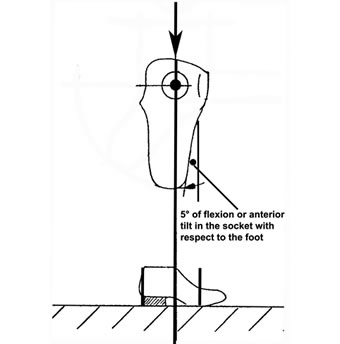
Fig. 2:
standard flexion angle of the socket in the sagittal plane
|


