How a loft buyer used computer rendering and his own furniture designs to make 550 square feet pleasantly liveable for two
By Elvira Cordileone
REAL ESTATE REPORTER
Saturday, June 29, 2002
There are those among us who know how to trick tiny spaces into acting bigger.
In the spring of 1999, Peter Raynes, 42, and his partner, Darryl McSherry, made an on-the-spot decision to buy a 550-square-foot penthouse loft. The location, at Portland St. and Front St. W., suited them, and at $149,000, including one parking space and several upgrades, the price was right. Raynes says the rooftop deck clinched the deal.
Soon after they bought the apartment, he started to wonder whether the narrow two-storey loft could actually accommodate them both comfortably.
"The main worry for me was the nine-foot, one-inch width of the unit. And then you also hear that, often when you buy on spec (from plans), the finished space is even smaller," he says.
But luck was with them and when they moved into their Portland Park Village unit (a Cityscape Development built by Daniels Corp.) in the spring of 2001, the finished products turned out to be a more generous nine feet eight inches.
But long before they moved in, Raynes — at one time a construction site superintendent who now holds a bachelor's degree in architecture and also graduated from the Humber College computer animation program — set about figuring out ways to make the space in their home more usable.
"I built a model, just like an architectural model, on the computer (from the floor plans). Once that's done it's easy to do different things." He says he modelled it mainly to show McSherry what he had in mind.
He shaved walls and tested the effect of various materials and finishes. He designed 3-D furniture and placed it in the 3-D model of the apartment to see how it would fit. At all times, he says his main focus was to open up the tall narrow spaces and let in more light.
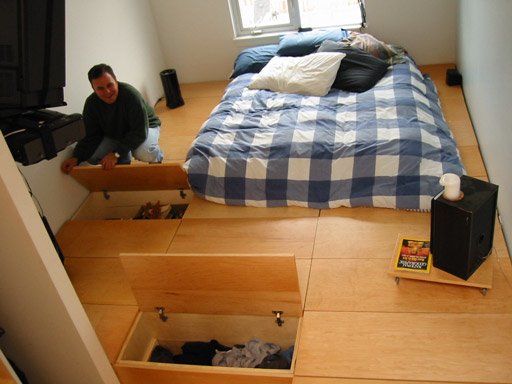
OPEN THE HATCH: Peter Raynes built a platform in his bedroom to create storage space in his 550-square-foot penthouse loft on Front St. W. The platform is two steps higher than the hallway floor leading to it and has nine lidded boxes.
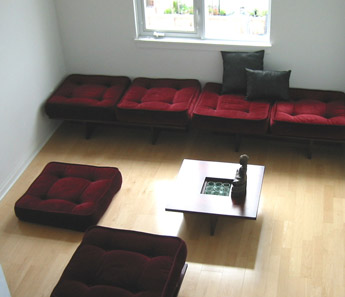
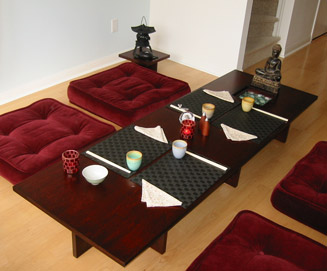
VERSATILE FURNITURE: Raynes designed and built sectional benches that serve as seating with cushions, or convert into tables for eating.
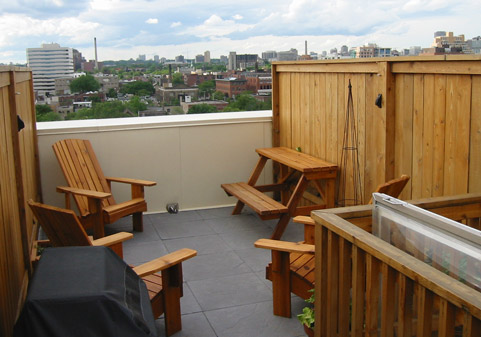
UP ON THE ROOF: The narrow deck includes a half-size picnic table, reached by a sunny skylight door.
Raynes took better advantage of the light pouring in through a plexiglass door leading to the deck from the second-storey bedroom staircase. On both levels, the staircase had been completely enclosed, so he removed its outside wall on the second storey and drew daylight deeper into the bedroom.
And to pull a little of that same light farther down to the main level, he partly opened up the stairwell there by chopping off the top of the outside wall. He says he also opened a four-inch gap between the stairs and the inside wall to create a sense that "something's going on upstairs with light."
Storage space was a particular concern because, despite the apartment's high, nine-foot ceilings, he didn't want to make it narrower by putting in dressers, tables and other large pieces of furniture.
"For the bedroom I started with the idea of a captain's bed with pull-out storage underneath," says Raynes.
But he ended up building a storage platform 12 feet by 9 1/2 feet, just about the length and width of the bedroom. The platform is now two steps higher than the hallway floor leading to it. It is made of nine boxes, three feet wide by four feet long by 16 inches deep.
Raynes built them off premises with three-quarter inch plywood, added lids finished in maple veneer to match the hallway, and then screwed the boxes to each other in the room. The boxes have all been subdivided into three smaller compartments each, except for the two under the bed used for storing larger items. The 23 compartments hold everything from socks to hanging folders. One even serves as their laundry hamper.
But Raynes says the platform also serves an important aesthetic purpose: because the bedroom area is now 16 inches shorter than the hallway, it changes the proportion of the end wall and makes the room look wider.
The main floor presented a similar challenge. Raynes used his computer to design the type of furniture he thought would work, then placed it in the 3-D apartment to test his ideas.
"The living/dining room is way too small for conventional furniture. Instead, we bought a bunch of Japanese-style floor cushions, each about the size of a sofa cushion, but firmer. Then we built some low table/benches — two square and two rectangular ones. The cushions can go on top of the tables or on the floor alongside them."
The tables are made of one-inch Baltic Birch plywood, stained cherry red. The four pieces can be arranged in many configurations: usually the benches are lined up under the window, with the square ones serving as coffee tables. But they can all be assembled to make one dining table, using the cushions as chairs, or rearranged to fit an inflatable queen-size mattress for overnight guests.
The furniture and the platform storage materials cost about $1,100. Raynes estimates the price might have jumped to $5,000 if he'd hired someone to do the work, but believes even that cost would have been well worth it because it makes their apartment so much more liveable.
Because the space is small, Raynes says he's taken pains to keep the look "minimalist." There are no dangling cords anywhere. In the bedroom, electrical wires are hidden under the platform. The television sits on a bracket screwed into one of the bedroom walls, its electrical cord threaded through the unit's only closet behind it along the hallway.
In that hallway between the mirrored closet and the bathroom is a nook where Raynes created a computer station. To keep the look clean, he built a computer table supported from the wall to keep the space open underneath it and threaded all the wires into the closet beside it. He built a sliding tray for the computer keyboard and another tray under that to hold a second sliding tray for an electronic piano keyboard.
"By the time I moved into the loft last year, I had studied the model so much I felt I was living in a holodeck program (a computer program in the television series Star Trek that allows characters to create and inhabit virtual worlds). But the woman across the hall, with an identical suite, burst into tears when she did her walk-through inspection because she had thought it would be so much bigger," he recalls.
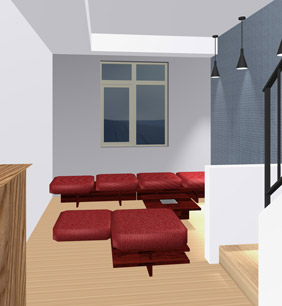
COMPUTER SIMULATION: The renderings that Raynes produced demonstrated his ideas to his partner, such as this living room arrangement.
Raynes has come out a winner because of buying that loft: He not only lives in a home he enjoys, but in the process of shaping it he began a new business. He created a company called Vroom 3D that offers virtual reality architectural visualizations from floor plans.
It takes about a week and about $300 to create the typical architectural model. Raynes says he keeps his service affordable by providing only the basics minus the small architectural details, such as mouldings and the decorations you might see at a mass market sales centre. The final model can incorporate specific furnishings that a client may want to include to see how they'll fit.
Raynes gives his clients a VCR video that shows "a fly-through" of the virtual suite, a CD-ROM and a series of two-dimensional pictures of the rooms and perspectives the client wants.
"My company wouldn't have been economically feasible even only a couple of years ago." Raynes says that computer speeds have become so fast he can render a set-up overnight that once took weeks.
Meanwhile, work is not entirely finished on his loft. Future jobs include unifying the two levels by putting light blue glass tile on the wall they shared along the staircase.
"I spend a lot of time, especially in winter, sitting in the living room and moving things around in my head," says Raynes.
For more information about VRoom 3D, visit http://www.vroom3d.com or call 416-389-2552.