| Introduction | Geopolitics | Food | Development | Environment | Home |
| Introduction | Geopolitics | Food | Development | Environment | Home |
| Glossary | Atlas | Search | Discussion | News |
 Population
When we use numbers such a million and billion, it is important for us to understand their meaning. Can we really comprehend how many there are in a billion ? To understand how large a number one billion is, we must attempt to equate it with something with which we are familiar. For example, if we talk about a person's life span, at what age would a person be when reaching their one millionth second of life ? or one billionth second of life ?
Try to do the calculation for one billion seconds of life..
The World's Human Population is now:
Even though we talk about almost 6 billion people on the planet, we must never lose sight of the fact that each person is a human being, entitled to the same respect, rights and priviledges that we expect. Each one of us make up the human family.
We commonly think of a billion as a very large number. Think for
a moment of the province of PEI and imagine if the entire world population
were standing side by side on the island. Would there be enough room ?
Would we need 10 islands ? 100 islands ?..... In fact, if all the world's
people came to visit the island and stood shoulder to shoulder, the island
would only be 36% covered in people! Difficult to believe but true. Now
does this mean that the Earth really doesn't have a population problem
? Well, can all of us live shoulder to shoulder ? No. Each person requires
space for housing, the growing of food, transportation routes etc. So,
in fact, our illustration shows us that we may have space enough for the
world's population to stand side by side but not necessarily for each of
us to live adequately.
(If you did the calculation for 1 billion seconds, you should have come up with 31.7 years of age.)
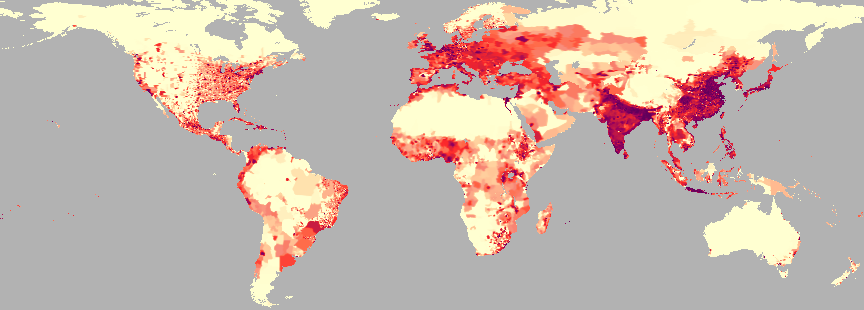
Below is an image showing the population density of the world. Notice how there are many areas of low population density suggesting those areas are inhabitable.