| Introduction | Geopolitics | Population | Development | Environment | Home |
| Introduction | Geopolitics | Population | Development | Environment | Home |
| Glossary | Atlas | Search | Discussion | News |
 Food
Food
If increased food production, reduced rates of population growth, or another Green Revolution will not solve the problem of hunger, what will? It is easy to say that people are hungry because they are poor, but why are they poor? Or more specifically, why are so many people unable to either grow or buy enough food to maintain themselves and their families in good health? Once again, there are no simple answers to these questions because the problems are not always the same in all parts of the world. The following factors, however, are usually common to most countries.
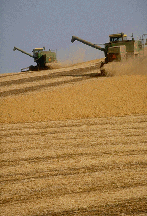
In North America and Europe the production of food has been increasingly subsidized by governments. By the late 1980s this had resulted in the creation of enormous food surpluses. In the United States, for example, the cost of these subsidies had risen from $2.7 billion in 1980 to $25.8 billion in 1986. Rather than store this surplus, some of it is exported to the LDCs, either at a low price or as aid. Such exports tend to keep down the price of food produced by LDC farmers, which reduces the incentive to improve domestic food production. At the same time, low food prices for certain products in the DCs make it difficult for exports from the LDCs to compete. Unnaturally low food prices are distorting agricultural markets eveywhere, and it is generally conceded that most subsidies should be eliminated. (This should not affect the provision of food aid during emergencies.)
While there are signs that governments in the DCs are becoming aware of the need to reduce subsidies, their reduction and removal is politically difficult. The subsidies exist, in large measure, to protect small farm ers. When they are removed many of these people may go out of business.
Without land or guaranteed access to it, a life of poverty is almost a certainty for the rural populations of the LDCs. One of the most difficult problems in many less developed countries is that a relatively high proportion of the best agricultural land is held by a small number of individuals and corporations. For example:
In South America 90 percent of the agricultural land is held by 17 percent of the landowners. (In Brazil, for example, in 1985, 60 percent of the land was controlled by 2 percent of the landowners, and it is estimated that close to half of this land was not being farmed. In that year there were 12 million landless farm workers in Brazil.) In Asia (except the Centrally Planned Economies) 60 percent of the land is held by 20 percent of the landowners.
Looking at this problem from the opposite perspective, in South America approximately 1 percent of the cropland must support over 30 percent of the rural population. while in Africa 4 percent of the land supports 75 percent of the rural population. However, these figures do not tell the whole story. The World Bank estimates that as much as 30 percent of the active agricultural population has no land at all. Yet even this kind of distorted land distribution might work if the first priority of a majority of landowners was to produce food for local consumption and if they paid local people adequate wages to do the work. But this rarely happens. Many of the larger landholdings are producing for export, which is causing a decrease in the production of food for local consumption. Further complicating the situation is the fact that the wages paid to hired labour are seldom sufficient to support a minimum standard of living.
Maximizing agricultural production is very important. It has been proven in country after country that the smaller holdings out-produce the larger ones on a per hectare basis. One reason for this is that the income of the large estates is so great there is little incentive to increase production further. On many of these estates large areas of land (as much as 50 percent in Brazil, for example) that could produce food are left out of production.
(You might wonder why the money earned by these large landowners doesn't help in the economic development of these countries. Why wouldn't it be used as investment capital to generate new enterprises, creating jobs and wealth? This issue is discussed in the next section on cash crops and agribusiness.)
The solution to the land problem is obvious. Land must be redistributed more equitably among the rural population. Not only must this process recognize all members of a community but particular emphasis must be directed toward seeing that women are given their share. There have been several efforts at land reform in recent decades, but outside of the Centrally Planned Economies, they have had little success. The reasons are not difficult to understand. Most of the landlords are wealthy and have considerable political power. They often form the government, or at least get a sympathetic hearing from its members. Where land reform has been tried, particularly in South America, the process has given the impression that a serious effort has been made. But in fact little has been accomplished because the rules were designed to favour the landlords. There have even been instances of large landowners forming their own private armies to protect their land and to intimidate the peasants.
In the Philippines. where it is estimated that 5 per cent of the population controls 90 percent of the wealth, a land reform program was introduced in June 1988. In its first stage, all estates greater than 50 ha (about 2 000 000 ha in total) are to be broken up and redistributed to 250 000 peasants, at a cost of over $10 billion; the whole process will take ten years to complete. A second phase began in 1992 when the largest group of agricultural land, farms between 24 and 50 ha, will be redistributed.
Unfortunately, both the landlords and the peasants are unhappy with
the process of redistribution in the Philippines. The landlords are unhappy
with their compensation-25 percent in cash and the remainder in government
bonds. Some landlords have threatened violence if anyone attempts to take
over their lands. The peasants aren't satisfied because they believe the
education and financial help they will need to farm successfully are inadequate.
They are afraid they are being set up for failure. While only time will
tell whether this plan will succeed, the consequences of failure could
prove disastrous for the Philippines.
Cash crops can be either nonedible (cotton, jute, flow ers, palm oil) or edible (coffee, cocoa, sugar, bananas, peanuts). The majority of these crops are grown in the LDCs for export. Governments encourage this type of production because it is a source of foreign exchange, which is needed to pay for imports, primarily manu factured goods (including armaments). In addition, export dollars are needed to make payments on the national debts that have been growing rapidly in many LDCs in recent years.
As a result of the emphasis on cash crops, in many LDCs there has been a reduction in the food produced for domestic consumption. There also has been a decreased need for rural labour because many of these cash crop farms are mechanized. And, as we have seen, further complicating the situation is the fact that for those who can find work, wages are usually very low.
It isn't difficult to see the negative impact of this kind of agricultural development on the rural peasants, particularly in countries where populations are still grow ing rapidly. This process has contributed to the migration to the cities of landless and jobless people. It has also made these countries vulnerable to food shortages and even famine during periods when drought or flooding may cause a reduction in local food supplies.
The term agribusiness refers to large corporations that are usually involved in several aspects of food production. Since most operate in many countries, they are called multinational or transnational corpora tions. Their primary function is to buy the crop, ship it to a processing plant, and market the final product. These firms do not always own the land the crops are grown on, but they usually supply all of the essentials for growing the crops, including seed, fertilizers, pesticides, etc. Companies that control their product from raw material to marketplace are said to be vertically integrated, and some of these companies are very large indeed. Some recognizable names with substantial operations in the LDCs include UniLever, Brooke Bond, Cadbury Schweppes, Firestone, Libby's (Nestle) Switzerland, Coca Cola, General Foods, and Standard Brands.
Answer the questions below and send them via E-mail .
1) Explain why subsidies are harmful to the individual farmers in LDCs.
2) Why is it difficult for land reform to occur in LDCs?
3) Why should LDC governments encourage the production of food crops for local consumption instaed of cash crops for export?
4) Define agribusiness.
 Send
your answers by e-mail to: mayfield@ica.net
Please make sure you give a title to your answer (ie. Answer to Factors
Contributing to Hunger)and sign your name.
Send
your answers by e-mail to: mayfield@ica.net
Please make sure you give a title to your answer (ie. Answer to Factors
Contributing to Hunger)and sign your name.
Text material taken from "The Global Challenge" Quentin
Stanford 1990. Oxford University Press. (pages 181-184)
Back to Food Table of Contents
