 IN OFFICIAL RELATIONS WITH THE WHO |
 |
 WORLD HEALTH ORGANIZATION |
| IN OFFICIAL RELATIONS WITH THE WHO |
|
WORLD HEALTH ORGANIZATION |
|
On the 26th and 27th of December 2002, the 2nd Prosthetic and Orthotic National Congress of the Kingdom of Cambodia was held. Of special note was official acknowledgement from the Royal Government and the election of officers for a new association of prosthetists and orthotists, now recognized as the Cambodian Association of Prosthetists and Orthotists (KhAPO). In attendance were representatives from all 14 Physical Rehabilitation Centres that provide services to people with physical disabilities in Cambodia, as well as the Ministry of Social Affairs, Labor, Vocational Training, and Youth Rehabilitation (MoSALVY). Attendees also included representation from the Disability Action Committee (DAC), the Cambodian School of Prosthetics and Orthotics (CSPO), the Phnom Penh Component Factory, and the Physical Rehabilitation Committee that is comprised of non-governmental organizations and other agencies that are responsible for the centres: The American Red Cross, Cambodia Trust, Handicap International (Belgium and France), The International Committee of the Red Cross, and Veterans International. 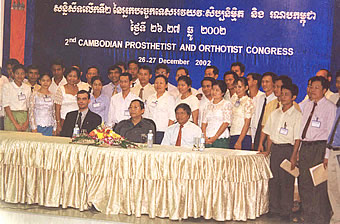 Participants of the 2nd Prosthetic and Orthotic National Congress of the Kingdom of Cambodia Cambodia has only recently begun to recover from the social, economic, and spiritual destruction caused by over thirty years of civil war and violence. The national infrastructure has been shattered, and the people of Cambodia are among the poorest and most vulnerable in the world. The GDP per capita in Cambodia is $257 USD and life expectancy for the combined population is 56.8 years. 1 As difficult as life in Cambodia is, it is even more so for persons with disabilities. Cambodia currently has one of the highest proportions of landmine disabled in the world, at an estimated one in every 384 people. 2 These existing victims and their families will require a lifetime of assistance to overcome their disabilities. In addition to the high number of landmine disabled, there are thousands more who suffer from disabilities caused by diseases such as poliomyelitis and measles, as well as inadequate pre and post-natal care and inadequate or inappropriate medical care for illness and accidents, all due to the total disruption and destruction of basic services. In response to this tremendous need, the above-mentioned organizations, through the Cambodian School for Prosthetics and Orthotics , have placed 55 ISPO recognized Category II Orthopedic Technologists in the country. "More P&Os are needed" states Mr. Bo Kim Song, an instructor at the CSPO and newly elected KhAPO Secretary for Continuing Education. There are 24 provinces in Cambodia and the 14 rehabilitation centres are only able to target service to 19 provinces. This leaves an untold number of persons with physical disabilities without attention. Approximately 6000 prosthetic limbs and 5500 orthotic devices are produced yearly at this time. |
Business, as well as continuing education topics and needs, was presented during the congress. Currently, funding for continuing education programs is obtained from the stakeholders of the Physical Rehabilitation Committee, as was funding for the recent ISPO Polio Conference held in Phnom Penh. Mr. Ma Channat, elected president of KhAPO, stated that the mission of the new association is "to preserve professional ethics, share experience and build a network of communication to expand and continue educational development for P&O in Cambodia." Mr. Kim Song added, "We need to continue to improve the quality of treatment in Cambodia. We also need to connect to other national associations so we can reach international standards." Future directions for KhAPO include leadership of P&O development on a regional scale (South East Asia), and eventual achievement of ISPO Category I recognition for national prosthetists and orthotists to enable participation in worldwide P&O development. Fifty one graduates of CSPO have now enrolled for membership to KhAPO. The topics of professional development presented at this congress included treatment of cerebral palsy, serial casting, orthotic design, and prescription. As not everyone can attend all conferences and seminars, especially those working in the remote provinces, the sharing of information in evidence at this gathering signified a level of professional growth for Cambodian Orthopedic Technologists. Category II individual case situations and treatment planning were largely represented in the presentations. A review of the recent ISPO Polio Conference identified strong and weak points of the 2-week seminar, and was significant in that Cambodian nationals, without international assistance, gave the analysis. Increasing sustainability of a professional level of prosthetic and orthotic services was in evidence at this Congress. "This association must be encouraged and supported for continuance of quality care for persons with physical disabilities," stated Jean François Gallay, chairman of the Physical Rehabilitation Committee and ICRC Head of Project. Indeed, the seeds of this effort to bring assistance to persons with disabilities in Cambodia are taking root and should be nourished. 1United Nation Development Program Contributions and inquiries can
be made to: |